
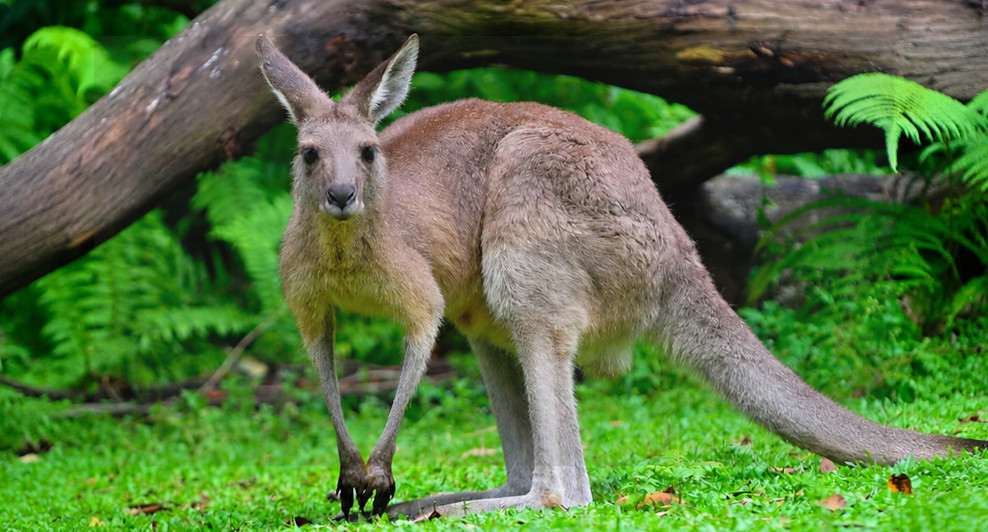
Kangaroos are sentient individuals with a right to their own lives, not a "natural resource" to be commercially exploited. In a submission on the proposed NSW kangaroo management plan, Vegan Australia has called for an end to the commercial killing and trade of kangaroos and for the commercial killing quota to be set at zero.
The submission argues that maintaining a sustainable kangaroo population does not justify killing individual kangaroos. It also challenges the language of 'harvesting' and 'management', which can obscure the reality that free-living animals are being deliberately shot and their bodies sold for commercial benefit.
Read the full submission below.
Vegan Australia welcomes the opportunity to comment on the proposed Wildlife Trade Management Plan for the Commercial Harvest of Kangaroos in New South Wales 2027-2031.
Vegan Australia is a national organisation that advocates for the rights of our fellow animals and for veganism. We envision a world in which all animals live free from human use and ownership.
We have followed the headings suggested in the consultation guidance. Our principal concern, however, extends beyond the technical operation of the proposed commercial killing regime.
The draft Plan assumes that killing kangaroos commercially is acceptable provided that it is 'ecologically sustainable' and carried out according to prescribed animal welfare standards. Vegan Australia believes that this underlying assumption should itself be questioned.
Kangaroos are sentient individuals with their own lives and interests. They have rights to bodily integrity, freedom from human exploitation and protection from being deliberately killed for human benefit. These rights do not disappear because an animal belongs to an abundant species or because their body has commercial value.
The stated goal of the Plan is to provide for the 'sustainable and humane commercial harvest' of kangaroos through the 'ecologically sustainable use of a natural resource'.
Vegan Australia rejects this characterisation of kangaroos as natural resources.
Ecological sustainability is important, but maintaining a viable population does not protect the rights of the individual kangaroos who are killed. Hundreds of thousands of individuals may be deliberately killed while the species as a whole remains abundant. A population is not the individual who is killed.
Population-level sustainability does not override the rights of individual kangaroos to continue living their own lives.
A practice does not become just because it can be continued indefinitely.
The purpose of kangaroo policy should therefore not be merely to retain enough kangaroos to maintain a commercially exploitable population. Government should establish the end of commercial killing and trade in kangaroos as its policy objective.
Monitoring specifically associated with commercial killing will no longer be required when commercial killing ends. It would be replaced by general monitoring of the health of the environment that includes kangaroo populations and other aspects of the natural environment.
The ability of kangaroo populations to withstand commercial killing does not justify that killing.
Kangaroos are sentient individuals with their own lives and interests. Their rights should not depend on the size or conservation status of the population to which they belong.
The appropriate quota for commercial killing is therefore zero.
The draft Plan notes that kangaroos are 'protected' native animals and that, without a licence, it is unlawful in NSW to harm, attempt to harm, buy or sell them. Licensing then authorises activities that would otherwise constitute offences, including commercial killing and dealing in kangaroo bodies.
There is an important contradiction here.
Legal protection should mean recognising and protecting kangaroos as individuals with a right to continue living their own lives, rather than creating a regulatory system under which protected animals may be killed and commercially traded.
A licensing system can regulate exploitation, but it cannot turn exploitation into protection. The licensing regime that permits the commercial killing and trade of kangaroos should be ended.
The first aim of the Plan is to "ensure commercial harvest of kangaroos in New South Wales is humane". It relies principally on compliance with the National Code of Practice for the Humane Shooting of Kangaroos and Wallabies for Commercial Purposes, together with accreditation and training requirements.
Reducing pain, fear and distress does not resolve the underlying injustice. Reducing suffering within an unjust practice is not the same as providing an ethical justification for continuing that practice.
Animal welfare asks principally how animals are treated while humans use or kill them. Animal rights asks the more fundamental question of whether humans are entitled to override the rights of other animals to their own life, body and freedom.
An 'accurately' shot kangaroo still has those rights overridden: their body is subjected to human violence and their life is deliberately ended for commercial benefit. Compliance with a code governing the manner of killing therefore cannot make commercial killing ethically acceptable.
The issue is particularly apparent in relation to dependent joeys. The National Code can prescribe ways of killing joeys after their mothers have been shot, but prescribing a supposedly humane method does not address why those deaths should be deliberately brought about in the first place.
The central issue is not simply how commercial killing is regulated, but whether kangaroos should be commercially killed and traded at all.
The Plan largely approaches kangaroos in terms of population 'management', grazing pressure, commercial utilisation and the maintenance of a sustainable resource.
Vegan Australia proposes a different starting point: kangaroos are fellow sentient animals living their own lives. Their rights and interests should be recognised independently of their usefulness or economic value to humans.
Conflicts between human activities and free-living animals may arise, but policy should begin by respecting the rights of those animals and prioritising coexistence and prevention, rather than assuming that killing them and commercially using their bodies is a legitimate 'management' strategy.
It is particularly concerning when kangaroos are treated as competitors with animals used in agriculture for pasture and other resources. The draft Plan itself discusses total grazing pressure and notes the greater monetary value placed on cows, sheep and goats as one reason kangaroos may be removed.
Human decisions to use land for animal agriculture should not create an entitlement to kill free-living animals who occupy the same landscape.
Respecting the rights of kangaroos means rejecting the assumption that humans are entitled to kill them because they compete with animal agriculture, because their bodies have commercial value or because their populations are considered sufficiently abundant.
Commercialisation adds a further problem. Once the bodies of killed animals have economic value, commercial interests can influence the continuation of the killing regime. Commercial trade should therefore not be treated as a neutral consequence of animals who supposedly need to be killed for other reasons.
Vegan Australia also recommends reconsideration of the language used throughout the Plan.
The Plan repeatedly uses terms such as 'harvest', 'natural resource', 'commercial utilisation' and 'management' to describe the killing and commercial use of sentient animals. Such language can distance readers from what is actually occurring and reinforce the assumption that kangaroos exist as resources for human use.
'Harvesting' is language associated with collecting crops or other resources. Applied to sentient animals, it can obscure the reality that individual kangaroos are being shot and killed. The Plan itself defines 'harvest' as shooting a kangaroo in accordance with the National Code - that is, killing them.
'Natural resource' is especially concerning because it does more than soften the language. It expresses the underlying assumption that kangaroos are resources available for human use, whereas they are sentient individuals with lives, interests and rights of their own.
Similarly, terms such as 'commercial utilisation' and 'management' can conceal the violence and commercial interests involved. Where 'management' includes shooting and killing animals, that should be stated plainly.
Government documents should use direct language such as 'shooting', 'killing' and 'commercial trade in kangaroo bodies' where these are what is meant. Clear language helps ensure that policy debate recognises the individual animals whose lives, bodies and freedom are at stake.
Vegan Australia recommends that:
The draft Plan asks how commercial killing of kangaroos can continue in a manner that is ecologically sustainable and meets prescribed animal welfare standards.
Vegan Australia submits that government should ask a more fundamental question: should sentient animals be treated as resources that humans are entitled to kill and sell?
Our answer is no. Kangaroos have rights and interests of their own, and public policy should protect those rights rather than regulate their commercial exploitation.
Greg McFarlane
Managing Director
Vegan Australia
Unsubscribe at any time. Your details are safe, refer to our privacy policy.
© Vegan Australia | Registered as a non-profit charity by the ACNC | ABN 21 169 219 854