

Vegan Australia has urged the NSW Government to refuse a major expansion of JBS's Corowa piggery, arguing that the proposal would further entrench a system in which pigs are treated as production resources rather than individuals with rights to their own lives, bodies and freedom.
The proposed Corowa Grower Farm development would add 31 new ‘grower sheds’, where pigs would be confined and raised until they are killed at the stage considered most profitable for the producer. The new sheds would be able to hold up to 148,800 pigs at one time, while the entire Corowa site would be able to confine up to 312,000 pigs at one time.
Vegan Australia argues that this is not simply an objection to one piggery, one species or one company. Recognising the rights of animals means opposing not only particular facilities, but the underlying institution of animal use.
The submission also asks the Department of Planning, Housing and Infrastructure to consider related JBS developments at Lowesdale, Rennie, Coreen and Mulwala as part of a broader regional expansion of the commercial use of pigs.
Vegan Australia says animal welfare standards cannot resolve the fundamental issue. Changing housing specifications, stocking densities or other conditions of confinement does not address whether humans are entitled to breed, confine and kill sentient individuals for human purposes.
The submission calls on the NSW Government to refuse the Corowa development and support a transition away from animal agriculture towards food production systems that do not depend on breeding, confining and killing animals.
Read the full submission below.
To: Department of Planning, Housing and Infrastructure
Attention: Belinda Kennewell, Contact Planner
State Significant Development assessment
Vegan Australia opposes the proposed Corowa Grower Farm development and asks that development consent be refused. We understand that the formal exhibition period has closed and provide this submission as late or supplementary correspondence for consideration during the assessment of the proposal.
Vegan Australia is a national organisation advocating for veganism and recognition of the fundamental rights of all animals. We envision a world in which our fellow animals live free from human use and ownership. Our objection to this proposal is not that pigs should be used differently or housed under different conditions. It follows from the broader principle that sentient animals should not be bred, owned, confined and killed for human purposes.
Pigs are sentient mammals with complex cognitive, emotional and social capacities [1, 2]. Each pig affected by this development is an individual with their own experiences and interests, including an interest in continuing to live, maintaining bodily integrity and exercising meaningful control over their own life. Treating these individuals as production units does not recognise those interests.
Planning and industry documents routinely describe pigs in aggregate and production-oriented terms such as ‘livestock’, ‘stock’, ‘herd’, ‘capacity’, ‘throughput’ and ‘grower’ or ‘market’ animals. Those terms can obscure the individual pigs affected. The proposal would authorise infrastructure designed around the confinement and eventual killing of very large numbers of pigs over the life of the development.
Animal welfare standards do not resolve this issue. Welfare regulation concerns the conditions under which animals may be used. It does not answer the more fundamental question of whether humans are entitled to use sentient individuals as resources in the first place. For this reason, our objection would not be addressed by changes to housing specifications, stocking densities or other conditions of confinement.
The Environmental Impact Statement describes 31 new ‘grower sheds’, where pigs would be confined and raised until they are killed at the stage considered most profitable for the producer. The 31 new sheds would be able to hold up to 148,800 pigs at one time. If the development proceeds, the entire Corowa site would then be able to confine up to 312,000 pigs at one time [3]. The proposal therefore goes beyond maintaining an existing operation. It would authorise substantial new infrastructure intended to expand and continue the large-scale use of pigs for food production.
Long-lived infrastructure shapes future production systems. Approving major new infrastructure for animal use would help lock in a system that depends on breeding, confining, transporting and killing animals for years or decades to come. Planning decisions should instead support a transition towards food and agricultural systems that do not depend on animal use.
This is not an objection to one species or one company. The same principle applies to animal agriculture generally. Recognising the rights of animals means opposing not only particular facilities, but the underlying institution of animal use. The Corowa proposal is significant because it is a concrete decision about whether that institution should be expanded further.
The Corowa project material identifies related JBS proposals involving the large-scale confinement and use of pigs at Lowesdale, Rennie, Coreen and Mulwala [3, 4]. These developments should not be considered merely as isolated sites. Together they represent a broader regional expansion and restructuring of the commercial use of pigs.
The Department should consider the cumulative consequences of these connected developments, including environmental, water, waste, traffic, biosecurity and amenity impacts. It should also consider their combined effect in committing land, capital and infrastructure to continued large-scale use of animals for food production.
The public interest is not confined to whether the operational impacts of each individual site can be managed. It also includes the direction of future development. Expanding infrastructure whose purpose is the systematic use and killing of sentient animals is not an appropriate direction for a future food system.
Many planning objections to intensive animal agriculture focus on whether particular harms can be reduced through improved management or conditions. Those matters may be relevant to the Department's statutory assessment, but they do not address the central objection to expanding a system in which pigs are bred, confined and killed for human use.
A development can comply with prescribed welfare requirements and still depend fundamentally on treating animals as property and production resources. Likewise, reducing particular forms of suffering does not justify breeding animals for a system in which their bodies and lives are controlled for human purposes and they are ultimately killed.
The appropriate response is therefore not to redesign the proposed piggery so that exploitation occurs under different conditions. It is to refuse further expansion and begin now supporting a transition away from animal agriculture.
Vegan Australia asks the Department to refuse consent for SSD-93652960. Our objection is not that this particular piggery should operate differently. It is that expanding infrastructure for breeding, confining and killing sentient animals perpetuates their treatment as resources for human use.
The same principle informs our position on animal agriculture generally. A future food system consistent with respect for animals' rights would not seek progressively different ways of exploiting animals, but would move away from their use altogether. Approval of substantial new infrastructure for confining and exploiting animals moves in the opposite direction.
Greg McFarlane
Vegan Australia
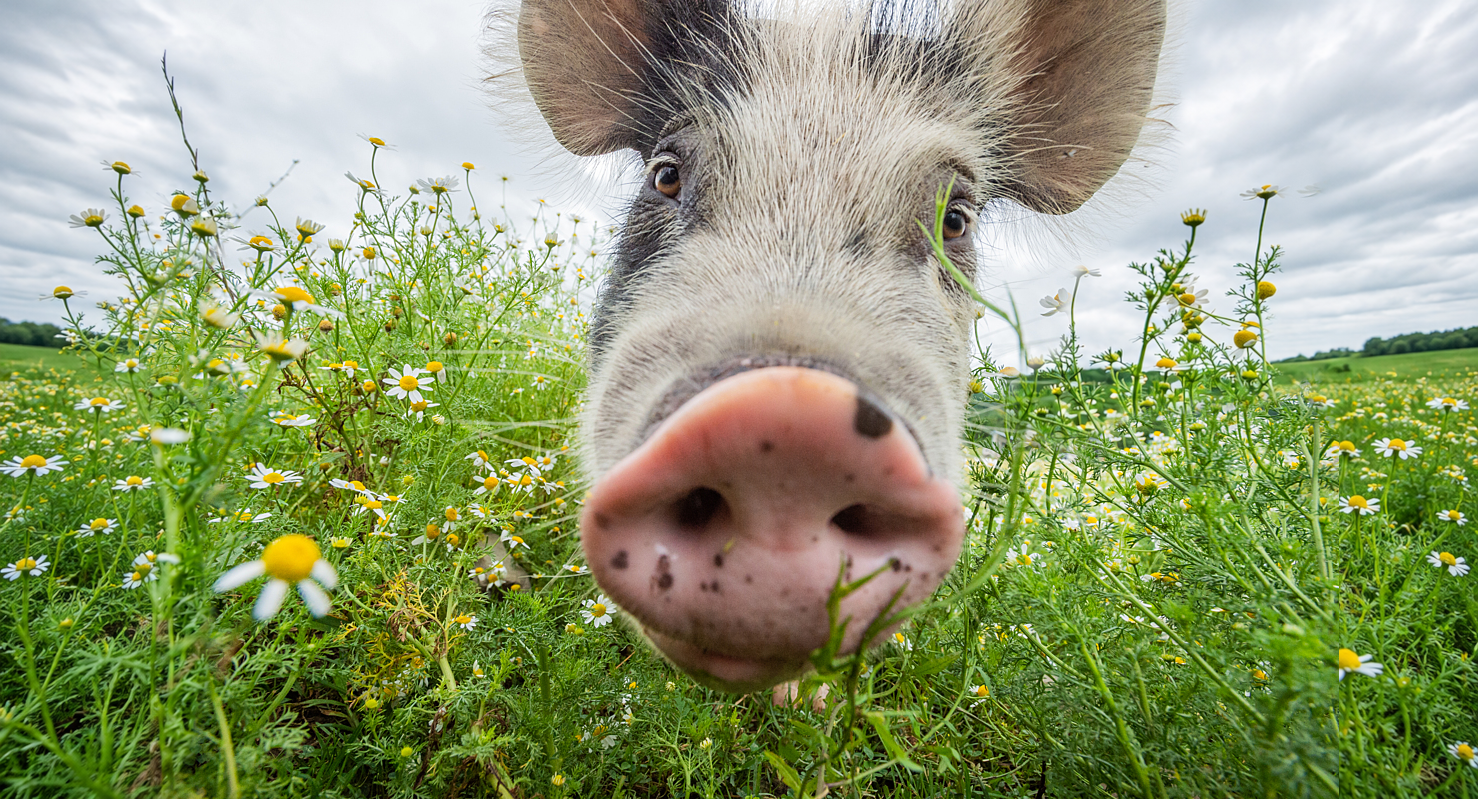
Image credit: A rescued pig at Farm Sanctuary, New York. Jo-Anne McArthur / We Animals
Unsubscribe at any time. Your details are safe, refer to our privacy policy.
© Vegan Australia | Registered as a non-profit charity by the ACNC | ABN 21 169 219 854


