
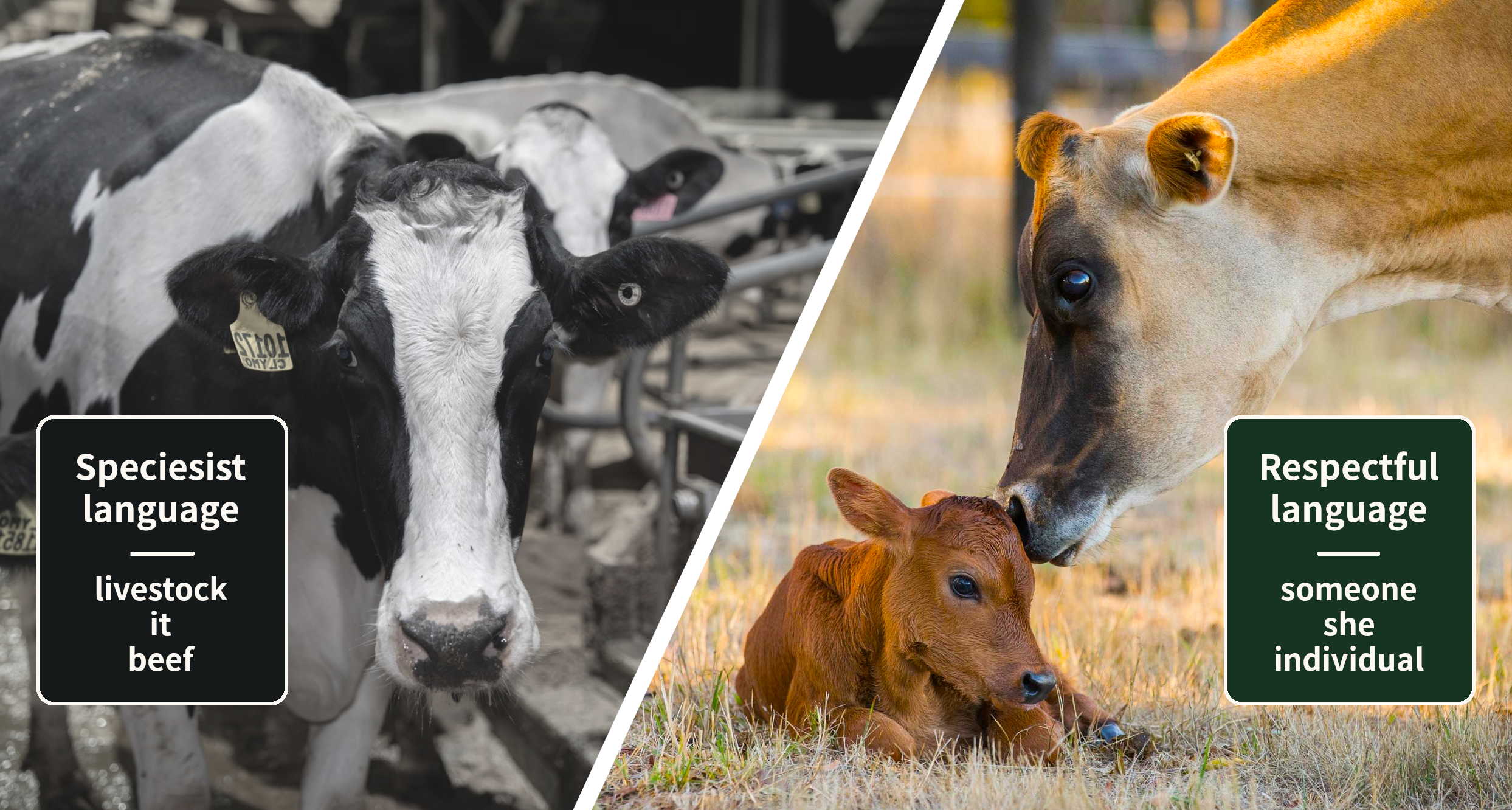
Language shapes how we think about our fellow animals. It can either reinforce the belief that animals are objects, resources and property, or help recognise them as sentient individuals with their own lives, interests and rights. Language can be used to build respect for our fellow animals or objectify them.
For example, the sentence 'Livestock are transported to processing facilities when they reach market weight' adopts industry language that hides both the animals and what is being done to them. A more accurate and honest sentence would be: 'Animals who are bred and raised for food are sent to slaughterhouses to be killed when the industry considers them ready.'
Speciesist language is language that reflects or reinforces the assumption that humans are entitled to use other animals. The example above shows that speciesist language is not rare, extreme or confined to obviously hostile language. It is often subtle and unintentional, and is embedded in everyday speech, media, education, law, advertising and animal industry terminology. It appears in ordinary words and phrases that describe animals as things, products, commodities, pests or units of production.
Non-speciesist language does something different. It names animals as individuals rather than objects. It avoids euphemisms that hide violence and exploitation. It does not make animal use seem normal, inevitable or acceptable. It helps us speak more truthfully about our relationship with other animals.
Changing language alone will not end animal exploitation. But language is part of the culture that makes exploitation possible. If we want a world in which animals are no longer treated as property or resources, we need language that challenges their objectification and affirms their status as sentient individuals.
Language does more than describe the world. It helps create the way the world is understood.
When animals are called 'it', 'livestock', 'pests', 'stock', 'produce' or 'resources', their individuality is hidden. When killing is described as 'processing', 'harvesting' or 'depopulation', violence is made to sound routine and impersonal. When animal products are described in ways that erase the animals they came from, the reality of animal use is pushed out of view.
These words are not neutral. They reflect a worldview in which animals exist for human purposes.
Non-speciesist language asks us to speak more accurately. Animals are not things. They are not products. They are not units of production. They are sentient beings with their own experiences, relationships, preferences and interests. Our language should not deny that reality.
Much everyday language treats animal use as ordinary and unquestioned. It does this by using words that describe animals from the perspective of the industries that exploit them.
Words such as 'livestock', 'poultry', 'seafood', 'game', 'dairy cows', 'laying hens' and 'meat animals' define animals by the ways humans use them. These terms do not describe who animals are. They describe the purposes imposed on them.
This matters because language can make exploitation appear natural. When animals are named according to their economic use, their own lives disappear from view. A cow becomes a 'dairy cow'. A fish becomes 'seafood'. A sheep becomes 'wool'. A hen becomes an 'egg layer'.
Non-speciesist language resists this reduction. It reminds us that animals are individuals before they are made into categories of human use.
One of the simplest ways to avoid speciesist language is to refer to animals as individuals.
This means using 'he', 'she' or 'they' rather than 'it' when referring to animals. When an individual animal's sex is known, 'he' or 'she' may be appropriate. When it is not known, or when speaking of animals generally, 'they' avoids turning a living being into a thing. Calling an animal 'it' is the language of objectification.
It also means using language that recognises animals as subjects of their own lives. Animals are not 'which' or 'that'; they are 'who'. They are not objects that something is done to without moral significance. They are beings who experience what happens to them.
This does not mean pretending we know everything about each individual animal. It means beginning from respect rather than objectification.
Many words used in animal-use industries are euphemisms. They make violence sound technical and detached.
Animals are not 'processed'; they are killed. Their bodies are not 'harvested'; they are taken from them. Forced breeding is not simply 'production'. Confinement is not 'housing'. Separation of mothers and young is not 'management'.
Euphemisms help protect people from the reality of what is being done to animals. They make systems of exploitation easier to accept by hiding the experience of the animals themselves.
Non-speciesist language should be honest. It should not exaggerate or use language carelessly, but nor should it soften or conceal the facts of animal use.
Some language hides exploitation. Other language acknowledges animal use, but frames it as acceptable if it is carried out in a supposedly better way.
Speciesist language often frames the problem as poor treatment rather than animal use itself. Terms such as 'humane', 'higher welfare', 'responsible farming' or 'cruelty-free' can suggest that animal exploitation becomes acceptable if it is carried out less harshly.
Non-speciesist language should avoid reinforcing the idea that the goal is better conditions within systems of exploitation. The issue is not how animals are used, but that they are used at all.
Language should therefore make clear that veganism is not a call for improved animal use, but for an end to animal use.
Veganism is often described as a personal choice, diet, lifestyle or consumer preference. This language can make veganism seem like one option among many, rather than an ethical response to injustice.
When veganism is framed as a 'choice', the rights of animals can disappear from the discussion. The issue becomes what humans prefer, rather than what animals are owed.
Non-speciesist language should avoid centring human preference where the issue is animal exploitation. Veganism is not merely about what someone chooses to eat or buy. It is about rejecting the use of animals for food, clothing, entertainment, experimentation and other human purposes, as far as possible and practicable.
This does not mean ignoring the practical realities of living vegan. It means keeping the ethical issue clear: animals are not ours to use.
Even well-intentioned language can be speciesist when it frames animals mainly as objects of human kindness, pity or concern, rather than as individuals with their own rights and interests.
Terms such as 'kind', 'compassionate' and 'loving' are common in animal advocacy, but they can make human feelings and virtues the centre of the message. They can suggest that animals depend on human kindness, rather than being owed respect as a matter of justice. Many people say they love animals, but love is not a substitute for respecting rights.
In other rights contexts, we would not normally say that people should be free from violence, confinement or exploitation because others are kind or compassionate. We would say they should be free from these things because they are not objects and because their lives matter to them. The same principle should guide how we speak about animals.
The word 'cruelty' can also suggest that the problem lies mainly in individual malice, bad motives or excessive harshness. But veganism is not a complaint against people with bad intentions, nor is the problem simply that animal exploitation is unkind or cruel. The deeper problem is the normalised belief that animals may be owned, controlled, bred, confined, used and killed for human purposes.
This kind of language can create a hierarchy between the helper and the helped. It is familiar from appeals that ask people to respond with pity or generosity towards others in need. But justice for animals should not depend on humans seeing themselves as helpers, rescuers or benefactors. Animals are not asking for charity or mercy. They are owed respect for their own lives, bodies and freedom.
Non-speciesist language should therefore avoid making humans the moral centre. The focus should remain on animals and the injustice done to them, not on human benevolence.
Non-speciesist language is still developing. Some changes are already clear, such as avoiding 'it' for animals and avoiding words that define animals by their use to humans. Other areas are still evolving.
This is not a weakness. It reflects the fact that our understanding is deepening. As more people recognise speciesism in everyday language, more words and phrases come into question.
The purpose is not to create rigid rules for their own sake. The purpose is to apply consistent principles: animals are individuals, not objects; their lives matter to them; and language should not reinforce their use, ownership or objectification.
When uncertain, the question to ask is not simply 'Is this the accepted term?' but 'Does this language respect animals as individuals, or does it make their exploitation easier to ignore?'
The examples of non-speciesist language are not arbitrary rules or isolated word substitutions. They are applications of broader principles.
The aim is not to create a new jargon or replace one set of slogans with another. The aim is to communicate clearly and truthfully, using language that respects animals as individuals and does not hide or normalise their exploitation.
Once these principles are understood, it becomes easier to recognise language that objectifies animals, hides exploitation, centres human preference or normalises animal use. It also becomes easier to use words that communicate respect, accuracy and justice.
In practice, this means asking questions such as:
These questions can help us speak and write about animals, veganism and animal use with greater clarity, accuracy and respect.
For detailed examples and guidance on applying these principles, read our full Guide to using non-speciesist language.
Unsubscribe at any time. Your details are safe, refer to our privacy policy.
© Vegan Australia | Registered as a non-profit charity by the ACNC | ABN 21 169 219 854