

Vegan Australia has joined the Vegan Society of Aotearoa New Zealand and Doctors For Nutrition in support of a letter to Woolworths Group, raising serious concerns about the reduction and marginalisation of vegan products in supermarkets across Australia and Aotearoa.
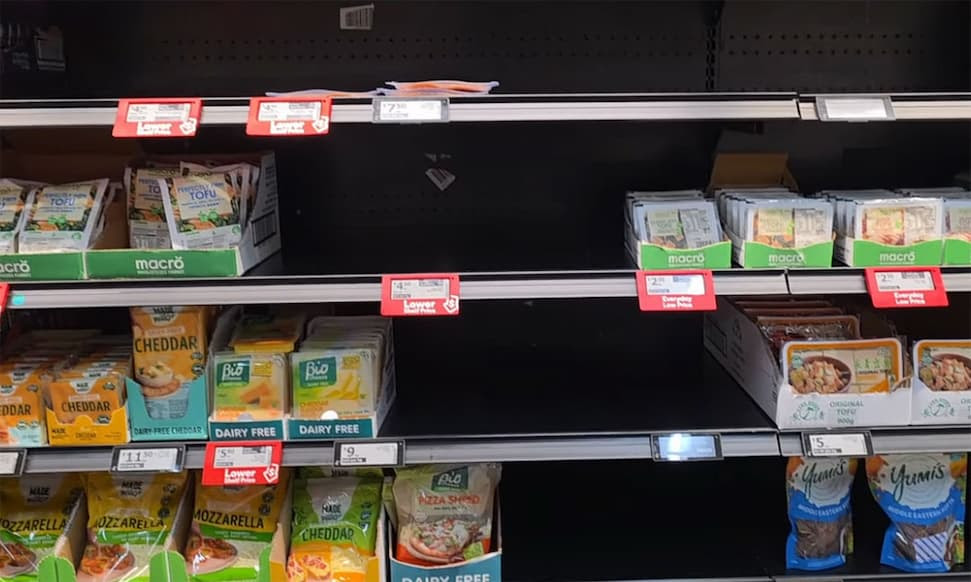
The joint letter highlights a growing pattern: fewer vegan products on shelves, reduced visibility and inconsistent placement that makes these products harder to find. These changes are not neutral. They shape what people see, what they recognise as normal and ultimately what they buy.
"Vegan Australia is proud to stand alongside our fellow signatories in supporting this letter to Woolworths," said Greg McFarlane, Managing Director of Vegan Australia. "We are calling for simple, practical changes to ensure vegan products are visible, clearly identified and integrated into everyday shopping, so that living without using our fellow animals is both accessible and supported.
A common claim is that supermarkets simply reflect consumer demand. However, retail environments actively construct demand through product placement, pricing, promotion and availability.
When vegan products are reduced, placed inconsistently or not clearly identified within standard product categories, they become harder to find and less likely to be chosen. Conversely, when they are consistently placed, clearly labelled and integrated into everyday shopping, they become part of normal purchasing behaviour.
This is why access matters. It is not only about those already living vegan, but about enabling a broader shift away from the use of animals.
Public responses to the announcement from the Vegan Society of Aotearoa reveal a consistent pattern across regions:
These are not isolated experiences. They reflect systemic retail decisions that are reducing the visibility and accessibility of vegan products.
At the same time, some comments point to a key issue: the assumption that vegan demand is too small to justify shelf space. This view ignores both the role of supermarkets in shaping demand and the significant proportion of the population open to vegan products when they are accessible and affordable.
Veganism is grounded in recognising animals as individuals with their own lives, not as products to be used. Supermarket practices that marginalise vegan products reinforce the idea that using animals is the default and unavoidable.
Ensuring that vegan items are visible, available and normalised is one step towards challenging that assumption.
The joint letter outlines practical steps Woolworths can take:
These are not radical demands. They are basic measures to ensure that products which do not rely on the use of animals are available and visible to the public.
Woolworths, as one of the largest supermarket groups in the region, has significant influence over food systems and social norms. With that influence comes responsibility.
The organisations involved in this letter represent over 130,000 people across Australia and Aotearoa who are calling for a shift away from practices that entrench the use of animals.
We look forward to Woolworths' response and to a constructive engagement on how supermarkets can play a role in moving towards a food system that no longer depends on the exploitation of our fellow animals.
Unsubscribe at any time. Your details are safe, refer to our privacy policy.
© Vegan Australia | Registered as a non-profit charity by the ACNC | ABN 21 169 219 854