
How reliable is nutrition research when conflicting financial interests are involved? A new systematic review has raised serious concerns about the influence of funding by the meat industry on nutritional studies examining the link between red meat and heart health.
While veganism is grounded in recognising animals as individuals with rights, discussions about diet are often shaped by scientific claims about health. The integrity of that science matters. This new review highlights how financial ties may influence what research appears to show.
The study, published in a leading nutrition journal, analysed 44 clinical trials looking at how the consumption of red meat is linked to cardiovascular disease risk. It compared studies where the researchers had links to the red meat industry against those conducted independently.
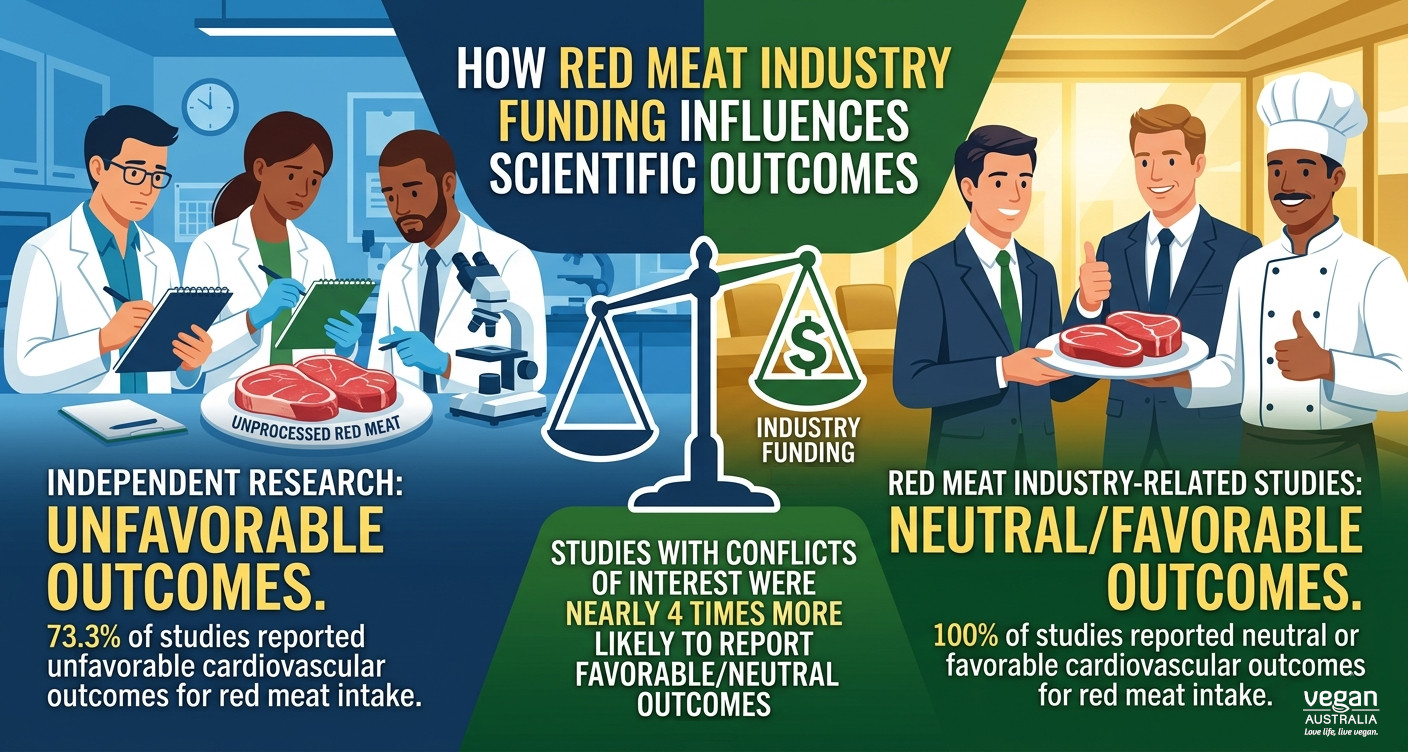
The findings revealed a clear pattern. All independent studies reported either neutral or unfavourable effects on cardiovascular health. In contrast, studies with links to the red meat industry were far more likely to report neutral or favourable outcomes.
In fact, studies with conflicts of interest were nearly four times more likely to report results that downplay potential cardiovascular risks. The review also noted that many studies linked to the red meat industry used comparisons with other animal meats, which may have obscured the benefits of shifting to animal-free foods.
Importantly, the authors situate these findings within a broader context. Studies of other sectors, particularly the tobacco and alcohol industries, have long demonstrated how funding from industries with conflicts of interest can bias scientific outcomes and delay public health action. Nutrition research is not immune to these pressures. Previous work has shown that studies funded by the animal-using industry are more likely to produce conclusions aligned with commercial interests.
The review also points to the wider role of the red meat industry in shaping public understanding, including efforts to downplay impacts on health and the environment. While individual studies may appear neutral, patterns across the evidence base reveals systematic bias.
The authors concluded that involvement by the meat industry in nutritional research may lead to an underestimation of the cardiovascular risks associated with red meat consumption. Overall, the strongest evidence came from the research led by independent researchers, which more consistently found negative impacts on heart health.
These findings reinforce the need for critical scrutiny of nutrition science, particularly where financial interests are involved. A system that depends on using animals is supported not only by production and marketing, but also by research that can shape public perception.
When industries that profit from animal use shape the narrative, the truth about both health and ethics can be obscured.
What is not in question is that our fellow animals are sentient individuals, not commodities, yet they are bred, used and killed to sustain an industry that works only to protect its interests.
Moving towards a just society will require a thorough questioning of how knowledge is produced and whose interests it serves.
A food system rooted in justice, not exploitation, is possible.
Unsubscribe at any time. Your details are safe, refer to our privacy policy.
© Vegan Australia | Registered as a non-profit charity by the ACNC | ABN 21 169 219 854